
The Hidden Dependencies Behind Magic Apps
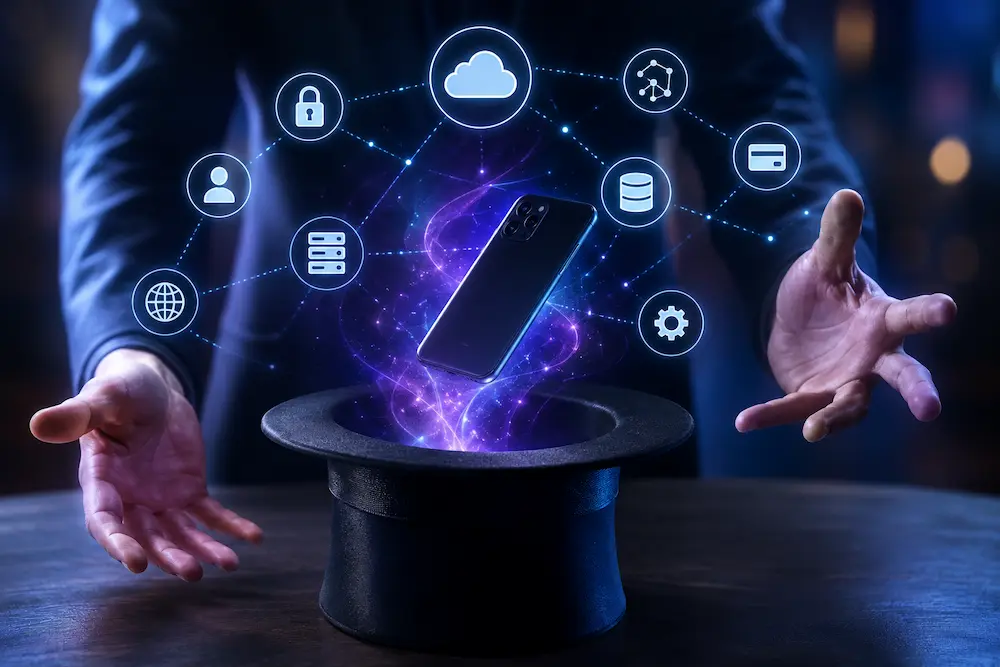
When you download an app, it is easy to think of it as a self-contained product.
You install it on your phone, open it, and expect it to work.
But many modern apps are not really independent pieces of software. Behind a simple interface can exist an entire chain of external services: internet connectivity, remote servers, APIs, authentication systems, cloud databases, third-party accounts, access tokens, paid credits, AI models, messaging services, and more.
For most applications, this architecture is simply part of modern software development.
For a magic app, however, these dependencies deserve much more attention.
Because when an app is part of a performance, reliability is not just a technical concern.
It becomes part of the method.
The App You Download Is Sometimes Only the Front End
Some magic apps can operate almost entirely on the device.
Once installed, they may need very little beyond the phone itself. Calculations, interfaces, predictions and secret mechanisms can all happen locally.
Others work very differently.
The app installed on your phone may only be the visible part of a much larger system.
Behind it, the app might need to communicate with:
- a developer's server;
- a cloud database;
- an external API;
- a messaging or communication service;
- an AI service;
- an authentication provider;
- a remote web service;
- or another platform entirely.
None of these approaches is inherently bad.
External services can enable effects that would simply be impossible using a completely isolated device.
But they introduce something every magician should understand:
dependency.
The Most Obvious Dependency: The Internet
The first question is simple:
Does the effect still work without an internet connection?
For some apps, the answer is yes.
For others, the app may open normally while the actual method silently depends on reaching a remote server.
This distinction becomes important very quickly in real-world performance.
A restaurant basement may have poor reception. A theatre may have overloaded Wi-Fi. A corporate venue may restrict certain connections. International roaming may be unavailable. A mobile network may simply be unstable.
And sometimes the internet is technically available, but too slow.
An effect that works perfectly during rehearsal at home can therefore behave very differently in front of an audience.
In traditional magic, performers think about angles, lighting, reset time and environmental conditions.
With digital magic, connectivity becomes another performance condition.
APIs: Powerful, but Outside the Developer's Control
Many sophisticated applications communicate with APIs.
An API allows one application to request information or actions from another service.
This can be extremely powerful.
A magic app could use an API to send information, retrieve data, analyze an image, generate content, communicate with another device or trigger an action somewhere else.
But the moment an effect depends on an external API, part of the reliability of the trick moves outside the developer's direct control.
The API provider can experience downtime.
It can change its technical requirements.
It can modify its pricing.
It can introduce usage limits.
It can restrict access in certain countries.
It can change its authentication system.
It can discontinue a feature.
And, in the most extreme case, the service can disappear entirely.
The magic app may still be installed on your phone.
The icon may still be there.
The interface may still launch.
But a crucial part of the method may no longer exist.
When Another Company Becomes Part of Your Trick
This becomes even more visible with effects involving SMS, phone calls, email delivery, remote communication or other online interactions.
Some magic apps require the performer to create an account with an external service before the effect can work.
Technically, this can be a very sensible solution. Instead of a magic developer having to build and maintain an entire communication infrastructure, they can rely on an existing specialist service.
But from the performer's perspective, the purchase becomes more complicated.
You are no longer simply buying an app.
You may also need to create another account, configure it, provide payment information, generate credentials, copy API keys, purchase credits or maintain an active balance.
Suddenly, a magic trick involves a relationship between you, the app developer and one or several outside services.
And those external services are not designed around the fact that you may be standing in front of an audience when something goes wrong.
Free Today Does Not Mean Free Forever
Another important distinction is the difference between buying the magic app and paying for the infrastructure it uses.
An app might be sold for a fixed price while its underlying method continues to generate costs.
Sending messages can cost money.
Making phone calls can cost money.
Processing images can cost money.
Cloud infrastructure can cost money.
AI requests can cost money.
Some services offer free tiers or include a certain amount of usage. For a magician performing occasionally, that may even be enough.
But these conditions can change.
A service that is effectively free today may introduce tighter limits or different pricing tomorrow.
This raises an important question for digital magic:
Who should pay for the infrastructure behind the trick?
Should it be included in the purchase price?
Should the developer charge a subscription?
Should the performer connect their own external accounts?
Should usage be sold as credits?
There is no universal answer.
Each model has advantages and disadvantages.
But the magician should understand what they are buying — and whether using the trick itself can generate additional costs.
AI Introduces a New Dependency: Tokens
Artificial intelligence adds another layer to this problem.
When an application uses a remote AI model, the developer is usually not simply connecting to a free source of intelligence.
Each request can generate a cost.
AI services commonly measure usage through tokens — units representing the information sent to the model and the information generated in return.
An AI-powered magic app may therefore consume resources every time an effect is performed.
There can be input tokens for the instructions and context sent to the model.
There can be output tokens for the answer produced by the model.
And depending on the technology being used, there may also be separate costs for image analysis, speech recognition, voice generation, image generation, video processing or other AI features.
This changes the economics of an app considerably.
A traditional offline magic app can potentially be performed thousands of times after purchase without generating a new cost for its developer.
An AI-powered effect may generate an expense every single time it is used.
One performance costs very little.
Thousands of users performing the effect regularly can become something very different.
Who Pays for the AI?
That creates another important question:
Who pays for every AI request?
The developer can absorb the cost.
The application can require a subscription.
Users can purchase credits.
The performer can sometimes provide their own API access.
The app can impose monthly usage limits.
Or certain AI features can be reserved for a higher-priced version of the product.
Again, none of these approaches is necessarily wrong.
But it means that the business model of the app can be directly connected to the technical method behind the magic.
A one-time purchase is much easier to sustain when the product costs almost nothing to operate after the sale.
It becomes more complicated when every performance creates a new expense for the developer.
AI Pricing and Models Can Change
There is another complication with AI.
The magic app developer does not necessarily control the service itself.
The company operating the AI model may change its prices.
It may introduce a newer model.
It may retire an older one.
It may change usage limits.
It may modify API access.
It may alter the way the model behaves.
AI costs may also decrease significantly over time, which can benefit developers and users.
The problem is not that prices necessarily increase.
The problem is that they are external variables.
The economics of an effect can therefore depend on decisions made by a company completely unrelated to the magician who purchased the app.
AI Reliability Is About More Than Cost
With AI, price is only one dependency.
An AI-powered effect can also depend on:
- the AI service being online;
- the required model remaining available;
- acceptable response times;
- sufficient usage limits;
- API access;
- geographic availability;
- and the model behaving consistently enough for the effect.
That last point is particularly interesting for magic.
In many ordinary applications, slightly different AI answers are acceptable.
In magic, the result sometimes needs to be extremely predictable.
An update to an AI model could potentially change its responses or behavior even though the magic app itself has not changed.
This means that AI creates a very unusual type of dependency:
the method may partially depend on software that the magic app developer does not completely control.
Account Creation Is Also a Dependency
Not every dependency is an API.
Sometimes the dependency is simply an account.
An app may require you to create an account with the developer before it can be used.
Another may rely on an authentication provider, an email address, a license server or online activation.
There can be legitimate reasons for this: synchronizing devices, restoring access, protecting professional software, enabling remote features or connecting several services.
But an account creates another point of dependency.
What happens if you cannot log in?
What happens if the authentication server is unavailable?
What happens if the company disappears?
Can the app still be opened?
Can the effect still be performed?
For a magician, these are not merely software questions.
They can become performance questions.
Permissions Can Become Part of the Method Too
Modern operating systems protect access to sensitive parts of the phone.
An application might require permission to access Bluetooth, the camera, microphone, contacts, local network, notifications or location.
Sometimes those permissions are essential to the effect.
But they introduce another layer that must be managed.
A permission may accidentally be disabled.
A new version of the operating system may change its behavior.
The system may ask for confirmation at an inconvenient moment.
Another device may have different settings.
The more external conditions an effect requires, the more things the performer needs to understand before relying on it professionally.
The Dependency Chain Can Become Surprisingly Long
Imagine a fictional magic effect involving a spectator receiving an impossible message.
To the audience, the process might appear incredibly simple:
Magician → Phone → Magic App → Spectator receives the message.
Behind the scenes, however, the real chain could look more like this:
Magic App → Internet Connection → Developer Server → Authentication Service → External API → Communication Service → Mobile Network → Spectator's Phone.
And an AI-powered effect could add even more steps:
Magic App → Internet → Developer Server → AI API → AI Model → Response → Developer Server → Magic App.
Every link in that chain has to work.
When everything succeeds, none of this complexity is visible.
That is excellent engineering.
But when something fails, understanding the chain suddenly becomes extremely important.
More Dependencies Do Not Mean a Worse App
It would be a mistake to conclude that an app relying on external services is automatically inferior.
Some of the most extraordinary digital magic effects are possible precisely because devices can communicate with servers, APIs, AI models and other platforms.
Cloud infrastructure can synchronize multiple devices.
Remote services can make an effect happen hundreds or thousands of kilometers away.
Artificial intelligence can make interactions far more flexible.
Communication APIs can create effects that would be impossible using a phone alone.
These technologies expand what a magician can do.
The question is therefore not:
"Does this app have dependencies?"
A better question is:
"Are those dependencies appropriate, reliable and clearly explained?"
Local Processing Has a Special Advantage in Magic
There is nevertheless something particularly attractive about an effect that can operate entirely on the device.
If the essential method is local, the magician controls far more of the performance environment.
No internet.
No remote API.
No external account balance.
No token consumption.
No server waiting somewhere else in the world.
Switch the phone on, open the app and perform.
That simplicity has real value.
Especially for professional performers who may use the same effect hundreds of times in unpredictable locations.
Offline capability is therefore not merely a technical feature.
In some contexts, it can be a genuine performance feature.
Developers Face the Same Problem
This issue is not only relevant to magicians.
Developers of magic apps face difficult architectural decisions too.
Building every component internally is unrealistic.
Using established external services can dramatically reduce development time and can sometimes provide infrastructure that would be impossible for an independent developer to create alone.
Why build a global communication network yourself?
Why develop a complete authentication infrastructure?
Why operate enormous AI models yourself?
Modern software is built around services communicating with other services.
That is normal.
But every integration introduces a long-term responsibility.
The developer must think not only about whether the effect works today, but whether the infrastructure supporting it will still make sense several years from now.
For magic software, where performers may want to continue using the same effect for many years, that question matters enormously.
What Magicians Should Ask Before Depending on an App
Before introducing a digital effect into an important performance, it is worth understanding a few things.
Does the core effect require internet access?
Does it require an account?
Does it depend on an external service?
Do I need to create accounts with other companies?
Are there additional usage costs?
Does the effect consume credits or AI tokens?
Does it require an active subscription?
Can I test everything before performing?
What happens if an external service is temporarily unavailable?
Can any part of the effect work offline?
And perhaps most importantly:
Do I understand what my performance actually depends on?
You do not necessarily need to understand the technical method.
But you should understand the conditions required for it to work reliably.
Digital Magic Has a New Kind of Reliability
A mechanical magic prop has physical dependencies.
A deck can wear out.
A battery can die.
A thread can break.
An electronic device can lose power.
Digital magic introduces another category of dependency:
infrastructure that the performer cannot see.
Servers.
Networks.
APIs.
Accounts.
Cloud services.
Permissions.
Credits.
AI tokens.
Third-party platforms.
None of this makes digital magic less magical.
On the contrary, this invisible infrastructure allows creators to build effects that would have been almost unimaginable a few years ago.
But as magic becomes more connected, performers also need to become more aware of what sits behind the screen.
Because sometimes the most important question about a magic app is not simply:
"What can this app do?"
It is:
"What needs to keep working for this app to do it?"